Biography
Anthony Wigglesworth (b. 1979, Dublin, Ireland)
M.Phil. Music and Media Technologies (1st Class Hons),
Trinity College Dublin (2013)
Biography
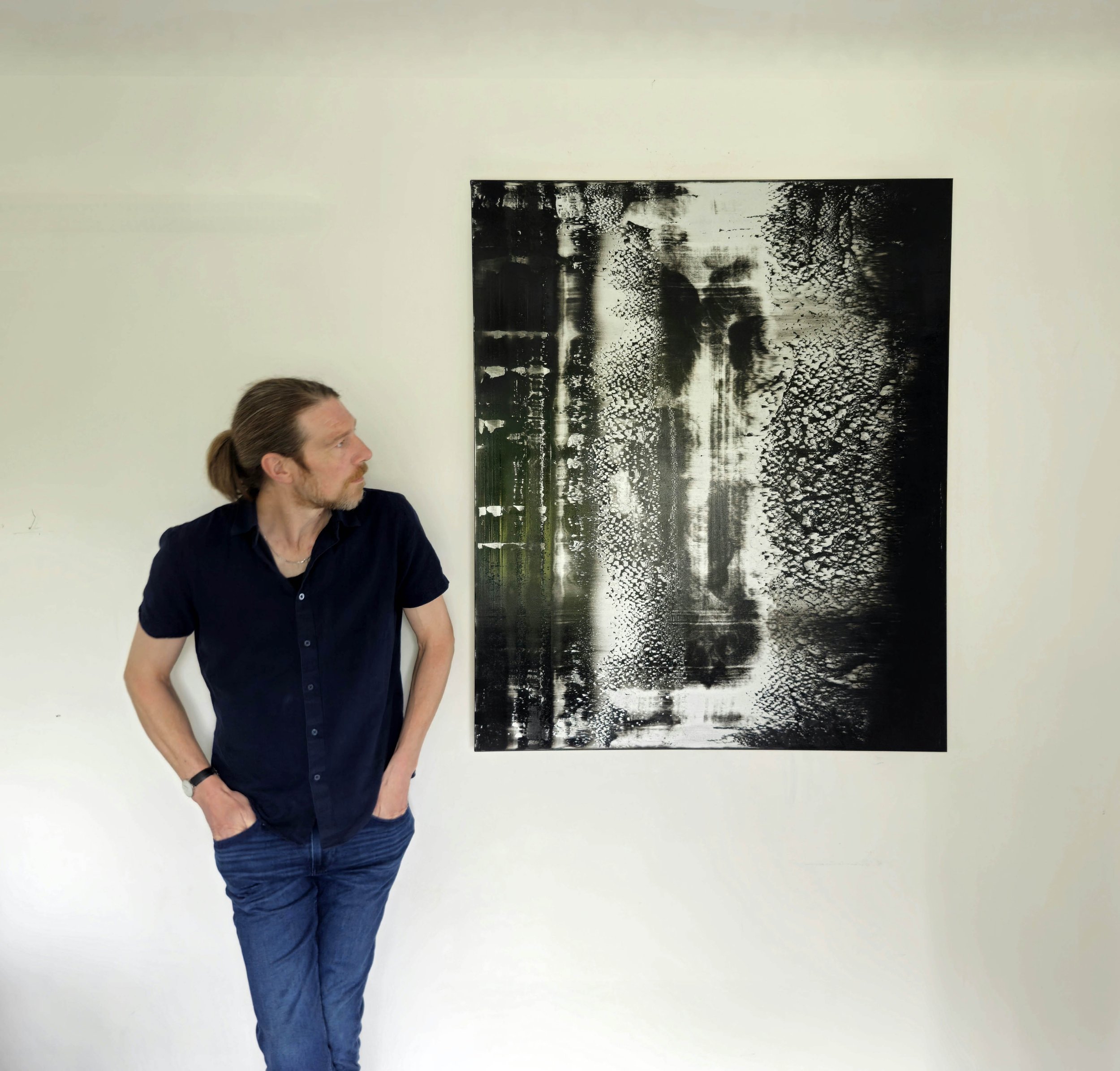
Anthony Wigglesworth (b. 1979) is a contemporary Irish artist whose multidisciplinary practice operates at the convergence of acoustical theory, information systems, and process-driven abstraction. Holding a Master of Philosophy in Music and Media Technologies from Trinity College Dublin, his studio investigations bridge visual rhythm, spatial illusion, and physical material.
His work is characterized by a process-driven investigation into the interplay between deterministic structures and stochastic systems, exploring the tension between ordered geometry and entropic dissolution. Utilizing custom-engineered tools and fluid dynamics, he navigates a continuous feedback loop between mechanical precision and organic unpredictability, where the artist’s calculated initial conditions meet the chaotic nature of the medium. This inquiry into responsive environments has been established through a significant exhibition history in New York and Miami. In 2019, his work was featured at The Sylvia Wald and Po Kim Gallery in Manhattan in the acclaimed exhibition Turbulence, alongside international artists represented in the permanent collections of The Museum of Modern Art (MoMA) and The Metropolitan Museum of Art. Most recently, he was one of three featured artists in the 2024 exhibition Genesis at the same venue, marking his third major presentation with the gallery.
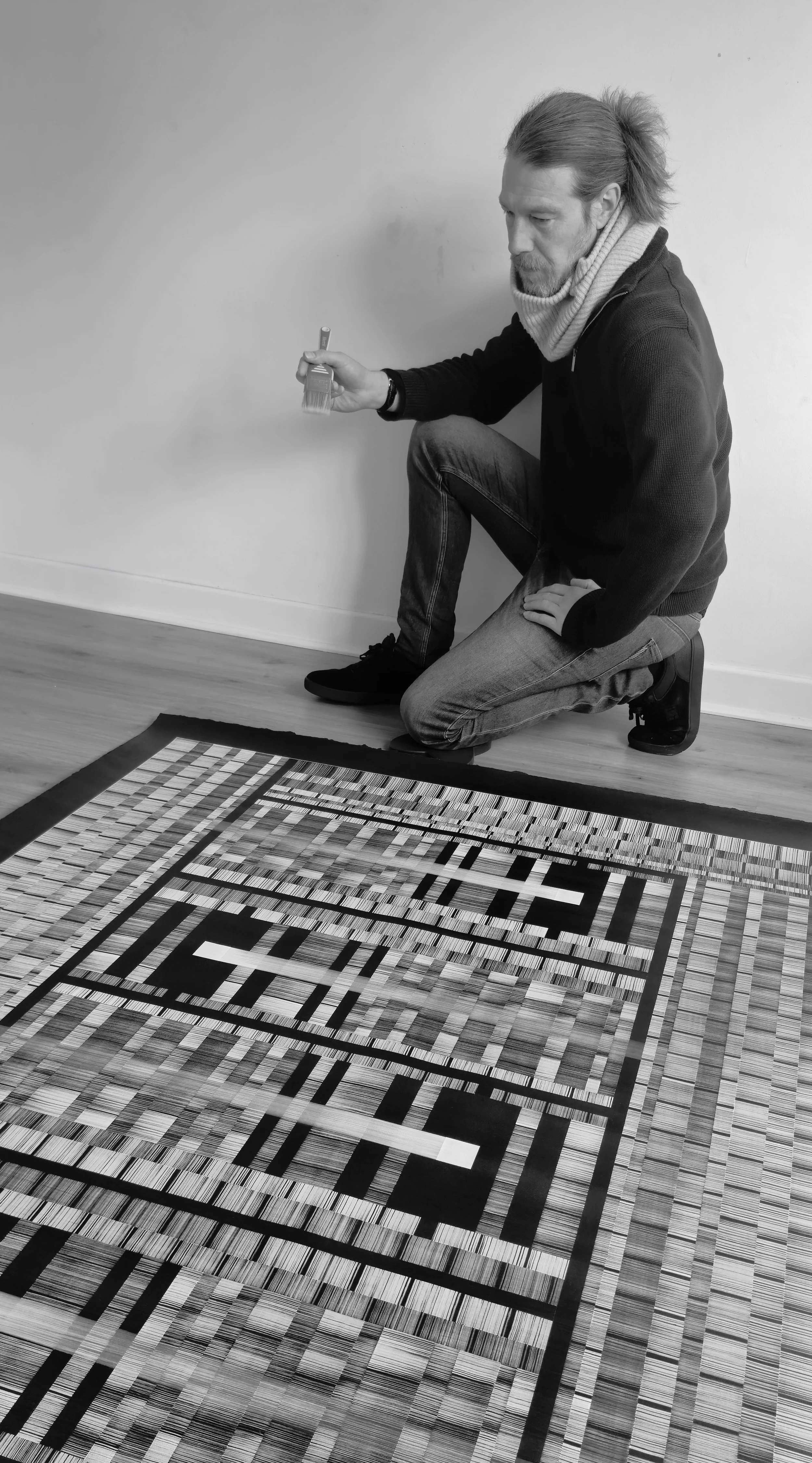
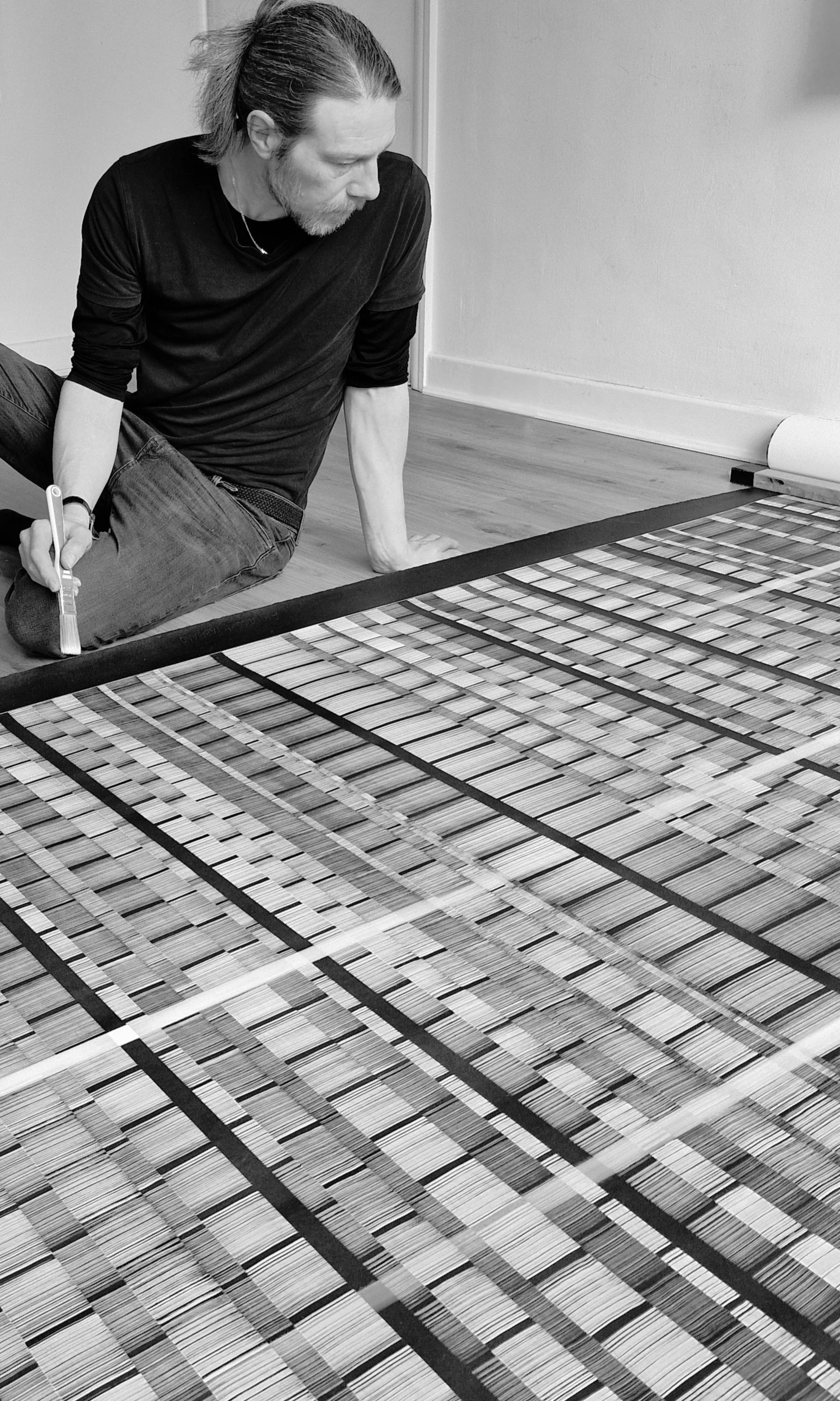
Wigglesworth’s dialogue with Information Theory is further distilled in his modular ink drawings, which capture ideas of time, light, frequency, and music as visual information. Frequently showcased in major art capitals, his work has been a recurring fixture at Art Miami, Art New York, and Art Market San Francisco.
Over the past two decades, Wigglesworth has established a prominent international profile through major solo presentations such as Harmonic Fields (2023) and On The Surface Of It (2018). His large-scale work, Solar Storm, is currently installed at the Irish Consulate on Park Avenue, New York, in collaboration with Culture Ireland and Donghwa Ode Gallery.
Based in Dublin, his studio practice functions as a laboratory for psychoacoustic and visual phenomena, shaping conditions in which material, time, and perception continually converge.
Artist Statement
Anthony Wigglesworth’s practice investigates the mechanics of information propagation, treating the surface as a site where time is rendered tangible. Unifying light and sound as dual manifestations of wave phenomena, each carrying energy and information through space, his work connects an early engagement with acoustic forms to visual abstraction. Here, rhythm, light, and structure organize into perceivable patterns at the threshold of potential energy. Operating as a temporal engineer, Wigglesworth constructs an architecture of duration and entropy.
In his ink drawings, Wigglesworth utilizes a disciplined, modular geometry to chart light and entropic processes. Architectural in construction, these works are built through the accumulation of thousands of discrete, incremental marks, mapping the gathering and dispersion of information across paper. Each gesture acts as a quantized moment, a single unit of ink and energy; collectively, they generate a continuum of light and shade that echoes wave propagation through a medium. As these structured networks overlap, they generate interference patterns akin to acoustic phase cancellation and optical moiré effects. In doing so, Wigglesworth is visually enacting wave-particle duality on paper, establishing a distinct rhythmic frequency that captures the subtle transition from structure to entropy.
This sequential logic translates directly into his oil paintings, where composition becomes an evolving, light-responsive event. Engaging with the fluid mechanics of pigment, Wigglesworth modulates viscosity across a spectrum ranging from saturated color fields to dark monochrome and metallic surfaces. Far from static images, these works function as optical transducers. They refract light dynamically according to the viewer’s perspective and shifting ambient daylight. As a result, the surface continuously fluctuates, recedes, and transforms as time unfolds.
Rooted in his research in Music and Media Technologies (M.Phil., 1st Class Hons., Trinity College Dublin), this interdisciplinary practice investigates how the human brain interprets and synthesizes aural and visual data, positioning the artwork as an active resonator for internal rhythms of perception.
“My studio functions as a laboratory for psychoacoustic and optical phenomena. I view the artist not merely as a maker of forms, but as a temporal engineer, shaping controlled conditions in which perception, light, and material continually renegotiate one another.”

Genesis (2024)
Anthony Wigglesworth | Samuelle Green | Han‑Chul Shin
The Sylvia Wald and Po Kim Gallery
New York
U.S.A.